Imprudent people believe everything, and they act recklessly. But they also are marked by something else: a quick temper. As Proverbs makes clear, “[a] man of quick temper acts foolishly.” But note what is interesting about the Proverb: It does...
Proverbs tells us not only that the simple believes everything, but also that the imprudent fool is reckless and careless. To be reckless or careless is to act without reck or care, (and no, that’s not wreck, like I wrecked...
Did you know that “neuro-physiologists at the University of Stuttgart have uncovered a connection between jogging and reduced intelligence. They tested more than 1200 people over a period of five years, and found that as the number of hours people...
This week, we will begin reflections on our school virtues: the seven classical or heavenly virtues, which consist of prudence, fortitude, justice, temperance (the four cardinal or human virtues), and faith, hope, and charity (the three theological virtues). Perhaps when...
The lesson of the boy who tried to take too many filberts out of the pitcher? “Do not attempt too much at once.” And the riddle of the bus driver who seemed to violate all those driving laws, and yet...
Well, you waited an extra day for the answers from last time, so I won’t make you wait any longer. The lesson from The Wolf in Sheep’s Clothing, according to Aesop, is: “The evil doer often comes to harm through his...
Welcome back – I hope everyone had a nice, long weekend. Next week, each morning I’m going to ask you to think about virtue—and specifically the seven classical virtues that we have posted around the school. What are they, where...
Well, it’s good to be back. Some of you might have noticed that Miss Blackstone and I have been gone for the last three days. If you didn’t notice, well then, so much the better. We were at Hillsdale College,...
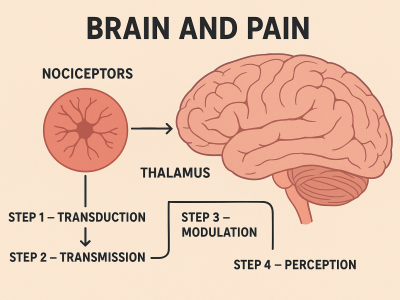
Even though feeling pain is about as basic a human experience as there is, the process by which our brains perceive pain is actually quite complex. It starts with transduction, where specialized nerve-endings called nociceptors detect harmful stimuli (like a...
The human brain is hardwired for music. The rhythms of the brain and body—your neurons firing, your breathing, your heartbeat—are all part of that hardwiring, and they all are activated an engaged when we listen to music. It is why...